A comprehensive introduction to thermoplastics and their uses: what are plastics; raw materials: main sources world-wide; primary production: converting raw materials into useful materials; classification of plastics; physical and chemical properties; methods of testing properties;selecting of materials: importance of matching end-use requirements with material properties.
Subjects: Chemistry
-
Ozone
A look at the Ozone including its molecular structure, physical properties, practical uses and the importance of the Ozone as a filter of UV A look at the Ozone including its molecular structure, physical properties, practical uses and the importance of the Ozone as a filter of UV radiation. Includes test methods for detecting the presence of ozone and the atmospheric processes that create and destroy it.
-
The Mole
This video tackles a concept students often find difficult with demonstrations and analogies. Coverage includes: a look at how substances react in definite proportions, the ignition (remotely) of various mixtures of hydrogen and oxygen, a nuts and bolts analogy to show fixed proportions, the mole and Avagadro’s number and using the mole to calculate chemical reactions.
-
Nature of Matter
Some of the key experiments performed between 1870 and 1940 which established the structure of the atom. Cathode ray tubes, canal rays, mass spectrometer, Thompson’s plum pudding model, Rutherford’s gold foil experiment, the Bohr model and the orbitals and quantumz mechanical model.
-
Non-Ferrous Metals
A comprehensive introduction to non-ferrous metals and their uses: what are non ferrous metal; raw materials: main sources world-wide; primary production: converting raw materials into useful materials; physical and chemical properties, methods of testing; secondary processing: methods of turning metals into products; properties & uses of : gold, silver, copper, brass, aluminum, magnesium, tin, titanium, zinc; properties and uses of major alloying metals: chromium, nickel, tungsten, vanadium; selecting of materials: importance of matching end-use requirements with material properties; recycling: importance and methods.
-
Nylon – Fiber to Fabric
Designing and engineering the properties of nylon to suit different uses from textiles to tractor tires. Topics include the polymerization process; extrusion, spinning and drawing; weaving, knitting and dyeing; market research into customer needs; garment design and manufacture.
-
The Magic of Chemistry
Witches cauldron – sublimation of dry ice; nylon rope – polymerization; cloth dyeing – structure affinity relationships; sea water flasks; liquid oxygen; chromium trioxide/ethanol; gun cotton; pouring race; “Old Nassau”; chemical rainbow; oxidation of methanol; oscillating reactions; flash bulbs; luminol, flash bang tubes. The 1988 Nyholm Lecture.
-
I Came, I Saw, I Redoxed
Cesium and his legion of Atoms set out to conquer the world. Unfortunately, he is attacked by oxygen and water. Mg, Fe and Na are oxidized. In a series of encounters/reactions many of the atoms are oxidized and reduced. We explore the activity series of metals. Cesium repairs the damage with Hydrogen, Carbon and Electrolysis.
-
Ionic and Covalent Bonding
Electro negativity determines whether a bond is pure covalent, polar covalent or ionic. The conductivity of salts, dissociation in water, covalent networks, the shapes of simple covalent molecules and the properties of small and long-chain covalently bonded compounds.
-
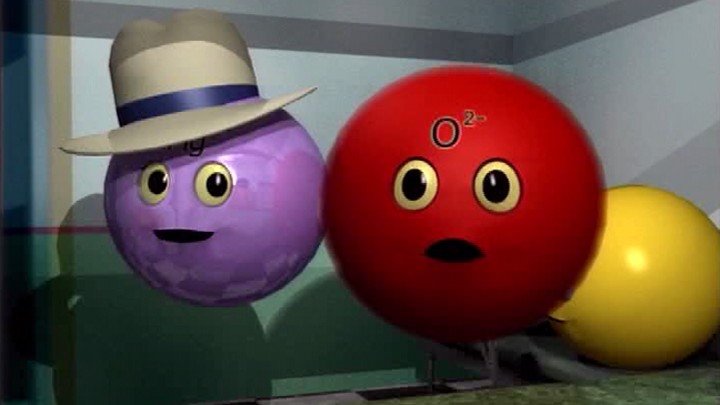
Holding Electrons
The attraction of each electron in an atom is unique. This is due to the charge on the nucleus, the distance and repulsion by other electrons.
IONIZATION ENERGY. The work required to remove an electron for an atom. No two electrons in an atom have the same value. This increases at certain stages leading to the energy shell model of the atom. ELECTRO NEGATIVITY. This is the number describing a particle’s ability to retain an electron in a chemical reaction. It describes and predicts the degree of polarity of a chemical bond. ACTIVITY SERIES. The ability of atoms to hold onto their electrons is also expressed in the activity series of the elements. The concepts of electron transfer and voltage production in cells are explored at their simplest levels.