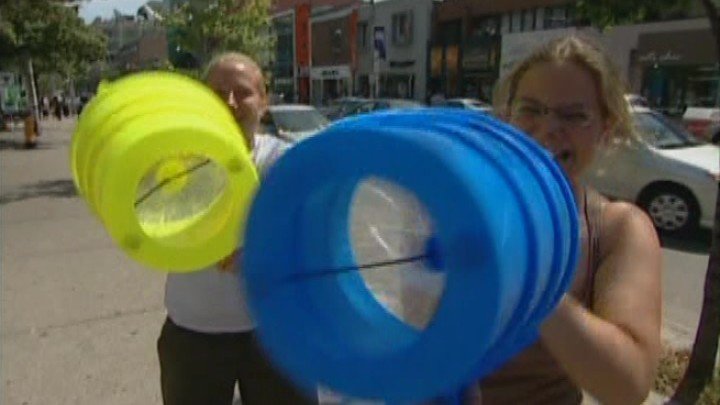
Create visible and powerful air currents.
Subjects: Chemistry
-
What Does a Sparkplug Do?
Replicate the controlled explosions unleashed inside your car engine hundreds of times every second!
-
The Egg-Splosion!
The rate at which combustion can take place is determined by the availability of oxygen. In this demonstration, hydrogen burns slowly until there is adequate mixing with oxygen to allow it to explode suddenly.
-
Building the Original Battery
Build a working replica of the basic electrochemical cell – the voltaic pile – constucted by Alessandro Volta in 1800, the world’s first battery.
-

Build a Simple Speaker
A plastic dish, a coil of wire and a magnet are the main components required to make a functioning speaker!
-
Acids and Bases Around the Home
This program familiarises students with the features of acids and bases, and discusses their physical and chemical properties. The pH scale is introduced with examples of strong and weak acids and bases and the concept of neutral substances is explored. The use of indicators to test the pH of acids and bases is explained, as well as showing the variety of indicators available and their specific uses. Students are shown how to make their own red cabbage indicator in the kitchen, and examples of acids and bases commonly found in the home are discussed. A description of neutralisation reactions and their products concludes the program.
-
Redox
Topics include origin of the name redox; evolution of the definition; electronegativity; oxidation number; half equations; how to write and balance redox equations; half cells; standard electrode reduction potentials; spontaneous and forced redox reactions.
-
Food Preservation
This video looks at food preservation methods and the factors that cause food to spoil. Factors affecting food preservation are examined: reasons for preserving food; enzyme activity in food; methods for controlling growth and killing micro-organisms; environmental factors: hygiene and packaging.
-
Particle Model & Kinetic Theory
Topics include stacking – crystals, angles and ionic radii; temperature – kinetic energy; solution; precipitation – particles stack as crystals; particles move fast – Brownian movement; gas has mass, KE, momentum; gas has pressure, temperature, volume; gas laws – P,V, and T in combinations.