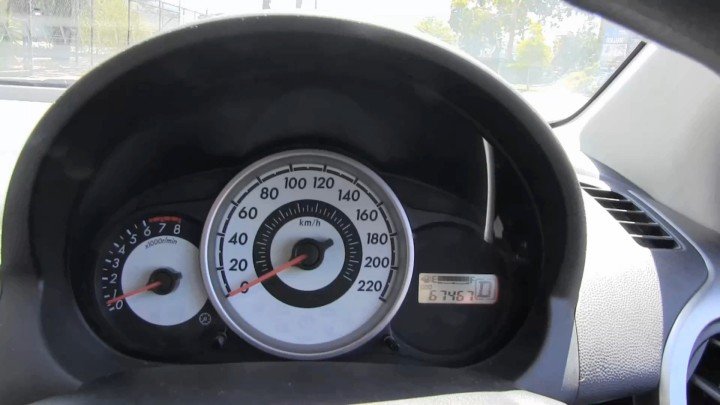
Presenter Spiro Liacos introduces students to the concept that speed is a measure of how far something travels in a given amount of time, looks at how speed varies in a sprint, explains the concept of velocity, and demonstrates a number of ways of measuring an object’s speed.
Subjects: Physics
-
Real World Science: Electricity
Electricity makes our lives easier every day. We use electricity in our work and play. Because electricity is virtually unseen, it is often difficult to understand just where it comes from and how it works. By watching the video and discussing the concepts presented, children will enhance their knowledge about electricity. The video presents general information about electricity, as well as concepts regarding static and current electricity, atoms and electromagnetism.
-
Real World Science: Forces
Real World Science: Force is one of a series of videos that encourages children to explore the world of science in their immediate surroundings. Through observation and experimentation, students will learn properties of forces, Newtons Laws of Motion and how pressure affects the world around them. This program encourages students to explore their surroundings and to discover the fascinating impact forces have on their everyday lives.
-
Real World Science: Magnetism
Magnets can be found in many objects that we use everyday. Not only are they located in man-made objects, but magnetic materials can be found in nature as well. In fact, the mineral, magnetite, was found to have magnetic properties long before humans learned how to make magnets on their own. By viewing the video and discussing the concepts presented, students will enhance their knowledge about magnetism. The video presents general information about magnetism, as well as concepts about atoms, and the relationship between electricity and magnets.
-
Real World Science: Matter: Solids, Liquids and Gases
Matter. It is all around us. Everything on Earth is made of matter. Learning about the different properties of matter will allow students to understand how environmental and human factors affect the changing world we live in. By viewing the video and discussing the concepts presented, students will enhance their knowledge about solids, liquids and gases.
-
The Cycles: Water, Carbon, Nitrogen, Phosphorus
Change is a constant of life. The natural cycles that balance and regulate our Earth and atmosphere provide the necessary conditions for sustaining a diverse range of life forms on the planet. But what actually occurs in these cycles? The Cycles Collection looks at the critical role the carbon, nitrogen, phosphorous and water cycles play in the life of plants, animals, bacteria and our planet. This motion-graphics driven program simply yet clearly explains the key stages and processes of each cycle and why the cycles are so important to all life on our planet. An ideal resource for viewers seeking a scientific understanding of these cycles.
-
Electrical Circuits
This program examines the basics of electrical circuits in detail. We look at various components of a circuit, voltage, current, resistance and Ohm’s Law, series and parallel circuits, and demonstrate a range of calculations for voltage, current, resistance, power and the use of Kirchoff’s Law. We look at how to use a multimeter, resistors and resistance color coding. Students are provided with clear verbal and visual explanations of the movement of current through a circuit, how it flows and how electrical energy is used, and easy-to-follow examples of how Ohm’s and Kirchoff’s Laws are applied.
-
Nuclear Radiation
This program covers the discovery of radioactivity, what makes atoms radioactive and methods for detecting radioactivity. The types of radiation including alpha, beta, gamma and positron radiation, types of decay, radiation dose & dose equivalence are explained. With application to real-life situations, the effects of radiation on living things, the environment and the uses of radiation in medicine are also discussed. This program is a comprehensive look at radiation that originates in the nucleus of an atom.
-
Mars Landing 2012: The New Search for Life
This one-hour special introduces the audience to a team of dedicated scientists who brought Curiosity to life. Brand new science and technology that had never been attempted made this mission a reality. From her custom-built heat shield designed to withstand intense 1,600 C degree heat and speeds up to 21,735 km/hr, to her state-of-the-art supersonic parachute. A revolutionary sky crane touchdown system was developed specifically for this mission, its job: get Curiosity to the surface of Mars. For the first time ever, a rover will be able to supply NASA – and the rest of the world – with stunning HD images from 17 different cameras. She will be able to zap rocks with a laser that’s as powerful as a million light bulbs focused on the head of a pin. She will drive for hundreds of kilometers and use her massive robotic arm to drill into Gale Crater to help answer questions of life. Curiosity is set to break all records.
-
Principles of Physics 2 – Sound, Magnetism, Electricity and Radioactivity
Physics is a science that describes how things work. Almost everything around us can be explained in terms of the principles of physics. With the use of practical demonstrations related to common activities, this program investigates some of the key concepts of physics. Using a drum kit we look at how sound works, how we make it, and how it gets around. We investigate electricity and electromagnetism and compare the similarities between a remote control car and a mobile phone charger. Finally, we take a look at radioactivity and discover a radioactive device that can be found in almost every family home.