With all the test results in, BMW begins making the new sports car at its massive factory in the tiny town of Dingolfing Germany. The enormous robots that will build the car have to be taught the moves that will help the company produce a car every 12 hours. Each car has some 5,000 individual welds. Follow the new car as it makes its way from the production line to its ultimate unveiling at the North American Auto show in Detroit.
Subjects: Technology
-
Weightless
Weightless takes audiences on a journey into zero-gravity aboard NASA’s KC-135 training jet. The film follows a group of university students who form a team – design, build, and finally fly with their project. All scientific concepts are clearly explained using common English and high-end computer graphics. The film provides a wonderful view into teamwork, technology, scientific thinking, and is underscored with a sense of adventure. With stunning visuals, state-of-the-art special effects, and narration by Christopher Lloyd, Weightless is an unforgettable journey for body and mind!
-
Iron and Steel Production
Topics include reduction, using carbon monoxide; destructive distillation of coal, pyrolysis; production of coke in a coking plant; charging of the furnace in the manufacture of pig iron; removal of impurities through the Bessemer process to make steel; recycling of scrap metal using an electric furnace; casting of molten steel.
-
Plastics in Manufacturing
Topics include INJECTION MOULDING – Items being manufactured. Moulds in two parts, the force and the cavity. Moving cores allow undercuts. Hot and cold sprues; ROTATIONAL MOULDING – For production of large and hollow items in thermoplastic. A large box and a canoe; VACUUM AND PRESSURE FORMING – The process and design considerations. Twin sheet process. Financial factors in choice of process.
-
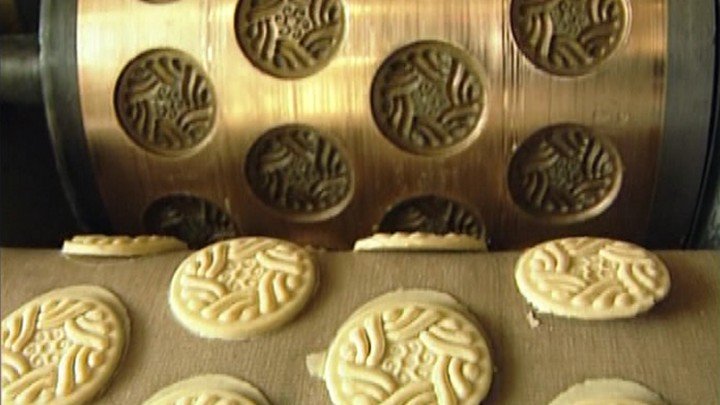
Cookies and Crackers
This video provides an inside look at mass production inside Arnott’s biscuit factory, showing stages of processing and manufacture. Topics include food additives are examined using two types of biscuit dough; use of fat for a short texture; how biscuits are shaped, cooked and hygienically packaged on the production line; quality assurance checks for contamination; food technologists developing new products.
-

Cotton Processing
Topics covered include spinning, weaving, dyeing, quality assurance, the design process, marking up, cutting and marketing.
-
They Made America – DVD
From the introduction of the steamboat to the advent of on-line shopping, Americans have always been endlessly inventive and eminently practical. They Made America examines innovation in America through the stories of the resourceful men and women whose ideas and inventions have transformed the world. Based on author and journalist Harold Evans’s book, They Made America also explores the political, social, economic, and environmental forces that make the United States an incubator for so much radical and far-reaching creativity. (4 hrs on 2 DVDs)
-
NOVA scienceNOW: How Does the Brain Work?
Host Neil deGrasse Tyson will tackle one of science’s major challenges in each episode, framed as a simple question that ordinary people wonder and worry about. Neil will guide us as he explores dramatic discoveries and the frontiers of research that connect each central, provocative mystery. Episode includes: 1) Magic and the Brain – Neuroscientists join Penn and Teller to explore why humans are so easily fooled by magic tricks. 2) Can Machines Think Like Us? – A computer named Watson is the latest contestant in machine v. human battles of the “mind.” 3) Magnetic Mind Control – Using magnetic wands, researchers can control the brain functions of human subjects. Sound scary? 4) Profile: David Eagleman – A neuroscientist finds inventive ways to study the brain-like sending test subjects into a terror-inducing free-fall.
-
NOVA scienceNOW: What will the future be like?
Mobile phones that read your mind? Video games that can cure cancer? Wearable robots that give you the strength of Ironman? David Pogue predicts which technologies will transform our daily lives. These advancements are already taking shape in laboratories around the world – and gadgets that once were purely science fiction are on the verge of becoming as common as the iPhones and Androids Pogue reviews every day.
-
Astrospies
Millions remember the countdowns, launchings, splashdowns and parades as the U.S. raced the USSR to the Moon in the 1960s. Few know that both superpowers ran parallel covert space programs to launch military astronauts on spying missions. In Astrospies, NOVA delves into the untold story of this top-secret space race, which might easily have turned into a shooting war in orbit. In Astrospies, viewers meet the elite corps of U.S. military astronauts, several of whom have never before talked about their clandestine training missions during the 1960s. As seen in footage broadcast for the first time, they practiced in full-scale mock-ups of the spy station, complete with spy cameras capable of resolving three-inch objects on the earth below. While the Apollo astronauts enjoyed ticker-tape parades, their astrospy colleagues trained in total obscurity until cost overruns and the new satellite technology doomed the program. Meanwhile, in response, the Soviets actually built three manned spy stations named Almaz and flew five missions during the 1970s. NOVA gains first-time access to a surviving Almaz station in a restricted Russian space facility, where an ex-cosmonaut demonstrates the high-powered spy cameras that were trained on U.S. cities. With a cannon designed to destroy hostile satellites-or attack American astrospies-Almaz was probably the only manned spacecraft ever equipped for space war. Astrospies is co-produced by Emmy Award winning producer Scott Willis and investigative journalist James Bamford, acclaimed best selling author of The Puzzle Palace and Body of Secrets.