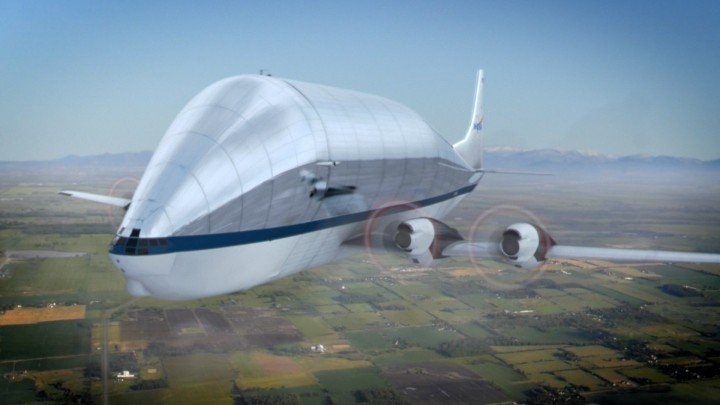
The Super Guppy carries NASA’s bulkiest and most cutting-edge aerospace components; join them on their mission to pick up and deliver a hefty piece of new technology for NASA’s latest experimental aircraft.
Subjects: Technology
-

Blue Angels
Thrilling millions of Americans every year with their death-defying aerial maneuvers and pinpoint precision, the Blue Angels are one of the best military display teams on Earth. Get ready for an up-close look at the six F/A-18 Hornets that make up the fleet. Meet the top guns who fly them, and the maintenance and support crews working nonstop to make each show a triumph. The stakes are high when you’re flying just inches apart at 700 miles per hour, a mere 15,000 feet above the crowd. Only the Blue Angels team can pull this off.
-
Sofia 747SP
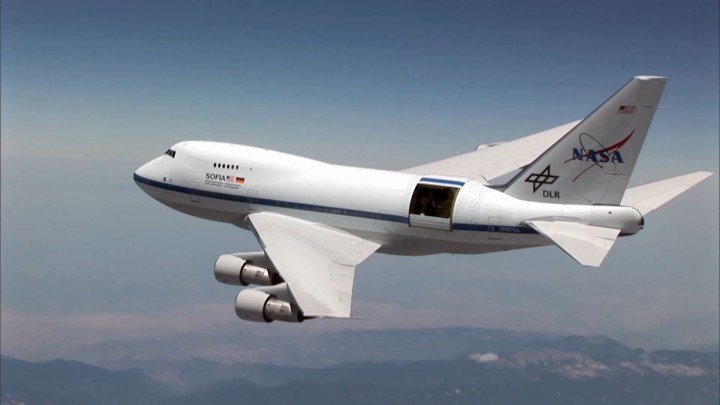
If you’re going to take on the universe, you’re going to need a Mighty Plane. Enter SOFIA, a Boeing 747 jumbo jetliner that’s been converted by NASA into a space observatory in the sky. Manned with a 17-ton telescope, she gives scientists and researchers access to targets that are out of reach to observatories on Eart-that is, when she’s airborne. She’s currently grounded for upgrade and overhaul maintenance, and four months behind schedule. The crew needs to work overtime to get SOFIA ready to, once more, unravel the mysteries of the cosmos.
-

CP 140 Aurora
The CP-140 is a spy plane built to protect Canada and her coastlines from unseen enemies; originally designed as a Cold War submarine hunter, she has been upgraded with the latest technology and we fly with her on a mock mission.
-
Airbus A380
On October 25, 2007 the Airbus A380 officially surpassed the legendary Boeing 747 Jumbo Jet as the world’s largest passenger airliner. At two hundred and thirty-nine feet long, the A380 has a tail as high as an eight story building and a wingspan that stretches nearly the length of a football field. It’s also the world’s first full double-deck passenger aircraft, making it a groundbreaking design in aviation history. Mighty Planes goes behind the scenes to look the A380 in a way that has never been seen before. Documenting the construction and delivery of a new aircraft leading up to the day when Lufthansa ultimately takes ownership. Experts examine every inch of the aircraft conduct an acceptance flight and check all the technical systems. Meanwhile teams at CAE in Montreal design and test the A380 simulator systems and Goodrich teams in Oakville, Ontario and Phoenix, Arizona manufacture and test the A380 landing gear and evacuation slides to ensure that every element of the new plane is ready to go.
-
Antonov 124
The Antonov 124 is the world’s largest serially manufactured cargo plane. Built to move Soviet military vehicles and equipment the 124’s went through a major overhaul at the end of the cold war in order to enter civilian service. Now they’re in constant demand moving everything from locomotives to whales anywhere in the world. Mighty Planes shadows an Antonov 124 and her crew on a mission of epic proportions. One year ago an earthquake destroyed a wind turbine used to power a cellulose plant in Chile. With repairs completed at a factory in Europe the plant is anxious to get the turbine back into service and they’ve put a call into the 124’s crew to get it from Dusseldorf to Santiago. For the Antonov 124 this flight comes in the middle of its typical thirty-day shift. Its crew of twenty make back-toback trips and always fly with tools and spare parts on board. They must be self-sufficient and able to fix ‘snags’ wherever they go.
-
C-5 Galaxy
The C-5 Galaxy is one of the largest aircraft in the world. At 247 feet long and over six stories high, this aircraft is the biggest and most powerful plane in the U.S. Air Force fleet. Dover Air Force Base in Delaware is home to thirty-two of these gigantic weightlifters, and they are constantly working. Mighty Planes will board a C-5M Super Galaxy for a record setting mission into a war zone documenting the entire process from the initial briefing, to crossing the Atlantic and finally the perilous descent into Bagram, Afghanistan. The flight crews need to pilot their giant aircraft through some of the most hostile airspace on the planet and execute a dangerous mid-air refueling.
-
Martin Mars
The Martin Mars water bomber is the world’s biggest seaplane. Originally one of five flying cargo planes it was built in 1945 for the US Navy. In 1958, it was converted into a water bomber and has since flown over 8000 firefighting missions. The four-person aerial crew flies the plane to the closest water source and scoops a full 27,200 litre load in just 35 seconds. Today, The Mars is owned by BC based Coulson Flying Tankers and used across North America to fight raging wildfires. Together with the Sikorsky S76 Firewatch helicopter the Mars water bomber is part of the most effective firefighting regime forest services can call upon when ground crews are powerless to extinguish the flames. Using HD and infrared cameras, along with state-of-the-art laser technology the S76 guides the Mars to a guaranteed bulls-eye with every drop.
-
Orbis
Mighty Planes joins the Orbis crew for their most challenging mission to date. A series of setbacks culminates in a compressor stall in flight and an around the clock effort ensues to get the plane back in the air and into Ulaanbaator, Mongolia. For the first time in its history the Orbis DC10 faces the very real prospect of failing to reach its destination. Waiting on the ground are patients who will lose the chance of regaining their vision if this angel of mercy is unable to fly.
-
Skibirds
We will join the men and women of the 109th AW as they fly their “Skibirds” to Greenland’s remote science camps on the final mission of the summer season. The barren, icy terrains keep crews on their toes, constantly testing their skills. The weather conditions are ever changing and can be nasty with blasting, unpredictable storms and unforgivable elements. The planes and crews will be pushed to their limits to persevere in the harsh environment on Greenland, a place that holds a world record for worst flying conditions on the planet. This mission will be trying from beginning to end and we will be there to see it unfold.