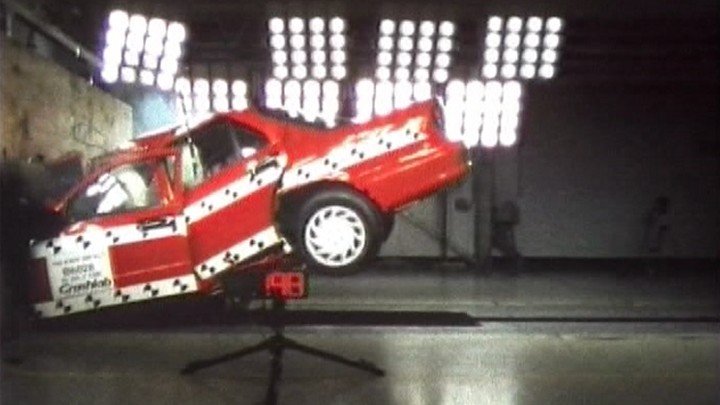
There are a lot of crashes in this video. We stop a car at different distances and graph the average stopping force vs distance and examine the following topics; concept of crumple zone to increase stopping distance in a crash, eEnergy and damage depends on square of speed, and stopping distance depends on square of speed.
Subjects: Physics
-
Physics – The Elegant Universe and Beyond
The Elegant Universe
Superstrings, Hidden Dimensions, and the Quest for the Ultimate Theory
Join host Brian Greene, professor of physics and mathematics at Columbia University and the best-selling author of The Elegant Universe, for an in-depth exploration of the groundbreaking new string theory that will excite scientists and non-scientists alike. If string theory proves correct, the universe we see obscures a reality that is far richer and more complex than anyone ever imagined–a universe with numerous hidden dimensions, a universe in which the fabric of space can rip and tear, a universe that may be but one of many parallel universes
Einstein’s Big Idea
Everyone’s heard of it, but what does E=mc2 really mean? With brilliant period recreations, discover how an obscure patent clerk, Albert Einstein, came up with his shattering 1905 discovery that the realms of matter and energy are inescapably linked. Starring Aidan McArdle (Ella Enchanted) as Einstein, and Shirley Henderson (Bridget Jones’s Diary) as Einstein’s first wife, Mileva Maric.
Einstein Revealed
Journey into the mind of a genius in this penetrating profile of the world’s most renowned physicist, who contributed more than any other to our modern vision of physical reality. Andrew Sachs (Fawlty Towers) stars as Albert Einstein. 412 min on 4 DVD -
The Elegant Universe
It’s the holy grail of physics–the search for ultimate law and order in the universe. And in the last few years, excitement has grown among scientists as they’ve pursued a revolutionary new approach to unifying nature’s forces. It’s called string theory and, to the uninitiated, it’s totally mind-boggling. But physicist Brian Greene has a rare gift for conveying physics in vivid everyday images, a gift that has turned his recent book The Elegant Universe into a mighty bestseller, and now Greene brings his talent and vitality to this documentary. Special DVD features include: materials and activities for educators; a link to The Elegant Universe Web site; closed captions; and video descriptions. (3 hrs. on 2 discs)
-
Newton’s Laws of Motion
This fast-paced program shows how Newton’s three laws of motion can be used to explain and predict the motion of everyday objects. The effect of friction, including air resistance, is highlighted and the concept of inertia is illustrated with classic demonstrations. The program features worked examples, questions for class discussion, as well as the remarkable Rocketman who provides a dramatic example of the third law in action.
-
Energy Rules!: The Conservation of Energy and Momentum
Underpinning the whole of physics are the twin laws of conservation of energy and momentum. This program examines the many forms of energy, momentum and how they are related. The nature of action reaction is demonstrated by two students on skateboards pushing each other apart. The idea of a “closed system” is investigated with the example of sprinters pushing off starting blocks and collision between cars and stationary fixed walls. Students are taken through appropriate calculations and introduced to the various concepts relating to the conservation of energy and momentum.
-
DC Electricity: Discovery and Developments
This program looks at the origins of electricity through the first uses of static electricity by the Greeks, Gilbert and onto other popular displays by scientists in the 18th and 19th centuries. Viewers will gain an understanding of the chemical battery, the ‘complete’ circuit, electrolysis, electroplating and negatively charged electrons. Resistance to flow is introduced and the use of both ammeters and voltmeters to monitor flow and potential. Highly effective animations will engage students, while clearly demonstrating processes.
-
Bohr’s Model of the Atom
This program focuses on Niels Bohr, who worked with some of the best physicists of the 20th century to devise his atomic model. Students will gain an understanding of the historical developments in atomic theories up to Bohr, a brief outline of Bohr’s life, Bohr’s first and second postulates and his influence on contemporary society. Featuring unique animation, plain English and frequent summarizing, students will gain a comprehensive understanding of the history and the theory of Bohr’s Atomic Model.
-
Beam On: Careers at the Synchrotron
Physicist Roger Rassool finds out who does what at a Synchrotron, and why they love their jobs. He discovers that many of them are young, and that you don’t necessarily need a PhD to work at this highly specialised facility. In fact, not everyone working there is even a scientist. The people he meets are: KYLIE ROGAN, Admin Officer/Project Support; Dr MARK BOLAND, Accelerator Physicist ; TRENT SMITH, Technician; SAM MICKLE, Accelerator Operator; Dr KIA WALLWORK, Beamline Scientist; Alan JACKSON, Technical Director. Along the way, Roger discovers the basics of how a synchrotron works, and some of its uses. This program will be of interest to both science and careers teachers. Its style is informal and very user-friendly. Which is probably why reaction to it has been so positive.
-
Nuclear Energy: The Issues
Nuclear power produces almost a fifth of the world’s electricity. Supporters say it’s safe, cheap and – best of all – the answer to global warming. Critics say it’s not safe, or cheap. And it won’t really help with the global warming problem. So who’s right? This program presents the arguments for and against, with relevant background information. Issues covered in this program include: radioactive waste: how hazardous is it?; Can it be safely stored?; How likely is an accident at a nuclear power plant?; What could the consequences be?; Are nuclear power stations terrorist targets?; Does nuclear power encourage the development of nuclear weapons?; Is nuclear energy ‘carbon-free’?; Is it the solution to global warming? NB: The science behind nuclear power – what nuclear fission is, how a nuclear power plant works and the ‘nuclear fuel cycle’ – is explained in more detail in a companion program: Nuclear Energy
-
Conservation Laws
Introduces the Conservation Laws. Examples of van Helmont, Lavoisier and Joule explain how scientific method led researchers to propose a hypothesis, design an experiment, record observations and draw conclusions and eventually become a scientific law.