Take a journey through space from the beginning, more than 4½ billion years ago with the birth of the sun; explore the far reaches of the solar system on icy cold Pluto. Learn about the origin of planets and their composition. Understand why planets are classified as rock, gas, or ice planets. See what Saturn’s rings are made of, why Venus is so hot, and why Pluto is so cold. Are there really little green Martians living on Mars?
Subjects: Astronomy
-
Starlight
Having done the grand tour of the universe, we now examine the light from stars and see how it can tell us about the stars within our galaxy. Covers: brightness, distance by parallax, Cepheid variables; spectra, color temperature, Fraunhofer lines, elements, fusion reactions; H-R diags, lives of stars of various sizes.
-
Our Solar System
Using NASA footage we look at; the sun; inner planets: Mercury & Venus; the Moon; asteroids; outer planets and their moons : Jupiter, Saturn, Uranus, Neptune, Pluto; comets; lunar exploration.
-
Stars of the Universe
Topics include scale to grasp the size of the universe; zoom out to nearby galaxies; big bang a short sequence; nebulae the nurseries of the stars; life of stars, the lives of 5 different stars,. brown dwarf, red dwarf, yellow star ( our sun) giant and super giant; supernova, black holes, neutron stars; binary stars, variable stars, x-ray binaries; variable stars, cepheid, pulsars, nebulae, supernova remnants.
-
The History of the Race to the Moon
This video uses historical footage to illustrate the super human effort of putting the first person on the moon. Topics covered include Early theorists, Tsiolkovsky, Goddard and Oberth; first satellites; chronological Soviet and American developments; Apollo 11 first landing on the moon.
-
Astronomy: Observations and Theories
Instructionally designed as an integrated learning system, Astronomy: Observations and Theories consists of 20 video programs, and a recommended textbook from Brooks/Cole Thomson Learning. This series was produced with the guidance of a National Academic Advisory Committee, which consisted of practitioners and theoreticians in the fields of astronomy, planetary science, and astrophysics. The advisory committee developed the course themes, reviewed and refined lesson topics and specific learning objectives, and evaluated treatments and scripts for content accuracy. Astronomy: Observations and Theories can be used as a supplementary resource or a complete one-semester college-level course. It explores a broad range of astronomy topics, concepts, and principles, from the motions of the visible sky to dark matter, from our own planet to the stars and galaxies. For textbook information and purchase, please contact Brooks/Cole Thomson Learning.
-
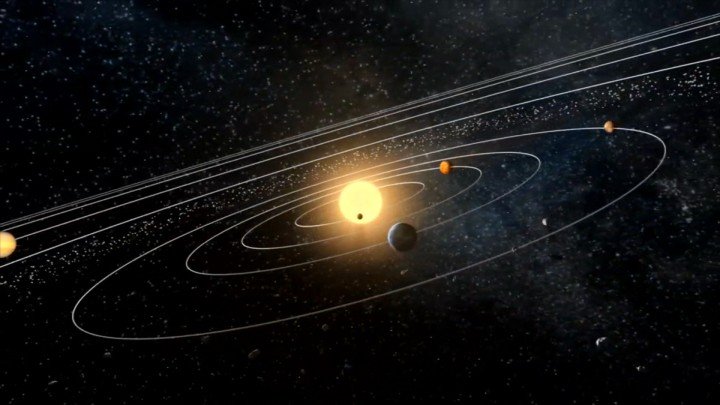
Earth and Our Solar System
Learn all about Earth and our solar system. What is the Milky Way? What comprises our solar system? What role does gravity play in our solar system and Milky Way Galaxy? What are the characteristics of the inner and outer planets? The answers to all of this are covered in depth with detailed graphics, diagrams and exciting video. On-screen, multiple-choice reviews at the end of each segment reinforce important concepts and make learning fun. Written by an educator and curriculum writer.
-

All About the Moon
Learn all about the Moon. How long does it take for the Moon to orbit the Earth? What causes the Moon to shine? What causes the phases of the Moon? What are the phases of the Moon? What is the Moon’s effect on ocean tides? The answers to all of these questions are covered with detailed graphics, diagrams, and exciting video, as well as on-screen, multiple-choice reviews at the end of each segment to reinforce important concepts and make learning fun.