This program takes us outside to an athletics track and inside to a battle of minds over a chessboard – exploring how nutrition plays a critical role in maintaining both a healthy body and mind. Our presenter, aided by young competitors, guides us through the role that nutrients play in our diets and the positive outcomes that can be achieved by making healthy and balanced food choices. We finish by taking a look at the journey food takes through our body showing how nutrients are taken in and waste products removed.
Grade levels: Primary (1-3)
-
Getting Along: Positive Communication
Communication is the transferring of information from one person to another and helps us in making new friends. The development of communication skills in children can help build positive interpersonal relationships. Effective communication skills help children to manage their emotions and to solve conflict without violence. This program looks at the communication skills needed to initiate, develop and maintain friendships at the individual and group level. Verbal and non-verbal skills are investigated, demonstrating why children need to be aware that there are different communication skills for different situations and audiences. Specific communication skills for interacting with adults are also investigated.
-
Gakusei Seikatsu!
Meet Yui and Yayoi – two Japanese teenage students who tell us all about student life in Japan. We learn about their school and the subjects they study; what they do in their spare time; what they eat; and about their families and friends. The girls also take us step by step through preparing and cooking okonomiyaki (Japanese pancakes), and the correct way to use chopsticks. This Australian-made, curriculum fit program is spoken entirely in Japanese and provides exposure to Japanese native speakers as well as cultural aspects of life in Japan. It is an excellent learning resource and is particularly helpful in aiding the development of vocabulary and grammar.
-
Science in the Garage
From the moment we open the door and enter a familiar, everyday family garage, we begin a journey of discovery about forces and their effects. From the family car to the kid’s bikes and skateboards, we explore a range of forces at work. In this fun and accessible Australian-made, primary curriculum fit program, we learn that energy is transferred through pushes, pulls and collisions and that when forces act on objects energy transfers are occurring even if we can’t see them. We find examples of gravity, friction, propulsion, air resistance, attraction and repulsion all lurking around the garage.
-
Science in the Kitchen
This program will completely change the way you view the average family kitchen! Where you would have once just seen food in the fridge, you will now find solutions, suspensions, chemical reactions, melting, mixing and dissolving! ‘Science in the Kitchen’ transforms an average family kitchen into a chemistry laboratory, where our student ‘scientist’ conducts simple experiments using common ingredients. By linking to students’ prior knowledge and life experience, this Australian-made, primary curriculum fit program demonstrates, in a clear, practical and entertaining way, key scientific concepts that students often find confusing, including: states of matter, chemical and physical reactions, and scientific methods and procedures.
-
Solving Linear Equations
Linear equations may appear confusing at first glance, but in fact there’s a very clear logic to them, once you understand how they work. In this program, we use a variety of fun and engaging real-world examples that students can relate to, to provide an engaging context to this core section of the Australian Maths Curriculum and bring linear equations to life. Reviewing a variety methods for solving equations, including guess, check and improve, the balance method and backtracking, the program takes students through the process of finding a numerical solution to various types of linear equations, from the simplest to the more challenging.
-
Algebra: The Basics
Algebra is one of the most powerful forms of mathematics we have devised. It helps us to study numerical patterns, and requires us to write them down in a special system of symbols. To understand how algebra works in this way, in this exciting program we travel to Hong Kong to search for patterns. This program explains the basic concepts of algebra including number patterns, pronumerals, algebraic expressions, order of operations and expanding and simplifying. The natural and city landscapes of Asia are used to bring to life these abstract concepts for students who are new to algebra or refining their skills.
-
Conductor and Strings
Bobby is a zany and enthusiastic young musician who wants to join the orchestra. But Strauss the Conductor must teach him a thing or two about the orchestra first… Through the antics of these two engaging puppet characters we gain an insight into the conductor and string section of the orchestra. We explore the history and development of ancient chordophones to the modern day violin, viola, cello, double bass and harp. We see these instruments in action and hear their sound qualities, exploring a range of playing techniques and varying timbres. This Australian-made, curriculum fit program also highlights the important role that the conductor plays within the orchestra.
-

Woodwind and Brass
Young Bobby, an enthusiastic and zany musician, has no idea about the orchestra, but luckily Strauss the Conductor is here to teach him before he joins up. Through the antics of these two engaging puppet characters we learn all about the woodwind and brass sections of the orchestra. We explore the history and development of ancient aerophones to the modern day flute, clarinet, oboe, bassoon, trumpet, French horn, trombone and tuba. We see and hear these instruments in action and explore a range of playing techniques and varying timbres. This Australian-made, curriculum fit program also shows woodwind and brass instruments being used in contemporary music.
-
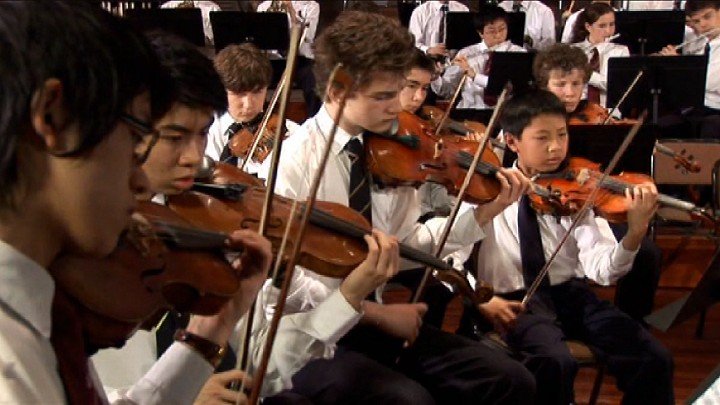
Percussion and Orchestral Diversity
Young Bobby is learning a lot about the orchestra from his new mentor, Strauss the conductor. But he still has more to learn before he can become a member of the orchestra. Through the antics of these two engaging puppet characters we are introduced to the percussion section of the orchestra, exploring the history and development of ancient membranophones and idiophones to modern day orchestral percussion instruments. We see and hear these instruments in action, exploring a range of playing techniques and varying timbres. This Australian-made, curriculum fit program also highlights important performers and outlines the typical orchestral idioms of today, various educational programs, and emphasises contemporary concepts.