This program interviews a number of people who work in the hospitality industry dealing with the public: receptionist, porter, duty manager, and restaurant/bar staff. Each section illustrates and describes the skills necessary for each job and the tasks commonly expected to be carried out. As the Public Face of the tourism industry these people have the responsibility of providing the best possible service they can for their paying clients.
Grade levels: Adult
-
E-Learning in Education
This program is about encouraging and inspiring teachers to incorporate e-learning as an integral part of the curriculum. It looks at a revolution in youth communication; the implications of the revolution for education: multilliteracies – what are they?; recent developments such as podcasts, vodcasts, mobiles, PDA’s blogs and online learning; and the way forward.
-
Emotional Intelligence in the Classroom
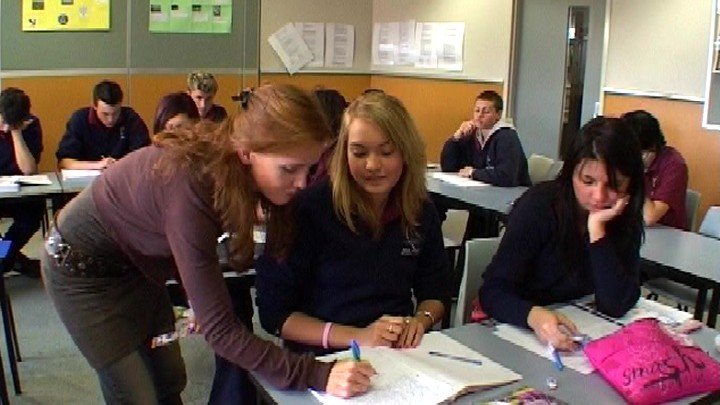
This program provides teachers with a basic understanding of what Emotional Intelligence is and how it can be utilized in the classroom to generate a positive learning environment. There is ample evidence now to suggest that emotional intelligence is more powerful than intelligence on its own. This program also provides specific ideas that teachers can incorporate in their classes to promote better emotional understanding which forms the basis for all relationships both in school and beyond into the workplace at a later stage. The program also focuses on why schools are ideal settings to promote the enhancement of emotional intelligence.
-
Climate Change: Our Responsibility
This program establishes the vital importance of the greenhouse effect for life on Earth and then presents a balanced argument to assess whether or not anthropogenic climate change (often called global warming) is in fact taking place. Clear arguments are presented on both sides of the debate and illustrations given covering both more economically developed countries and less economically developed countries, with impacts and responses fully explored. A thorough and balanced examination of this important and often contentious issue.
-
Homeostasis
Touch a hot stove and the muscles in your fingers will jerk your skin away before you’ve even registered the pain. Go for a run on a hot day and feel the sweat seep out of your pores. Stand outside in the cold in winter and count the length of time before your body begins to shiver. All these reactions are the result of homeostasis – that is, the mechanism by which our bodies – and the life support systems of all organisms – works to maintain a stable internal environment, despite changes in external conditions. In this program we’ll explore the concept of homeostasis. We’ll ask what homeostasis is, why it is important, take a look at detecting changes from the stable state, counteracting changes from the stable state, and how homeostasis works.
-
Natural Selection: Its Place in Modern Society
Natural Selection is a process which affects every species on Earth, including humans. This program illustrates how Natural Selection continues to affect us all in fundamental ways that will determine our future survival as a species. Included in the program is a brief explanation of Natural Selection, examples of how Natural Selection is operating all around us, how Natural Selection has affected human evolution and how it is still affecting our daily lives. The program concludes with the reciprocal view of how modern human society is affecting Natural Selection processes in the environment, and the consequences for the future of life on Earth.
-
Renewable Fuels
Traditionally we have relied heavily upon non-renewable energy resources, however we have now reached a tipping point globally where the environment cannot sustain such impact, nor do we have the resources to continue this. This program clearly shows the environmental impacts of both renewable and non-renewable energy sources. It guides us through numerous renewable energy sources, how the energy is collected and the pros and cons of renewable energy. The program also explores what is happening around the globe with the introduction of wind farms, wave parks and solar farms. This is an up-to-date look at a vital issue.
-
Nuclear Energy: Advanced Version – Metric
In addition to covering all topics in the basic version of Nuclear Energy, this program covers a number of advanced topics. Understand the use of water to vary reactor power, as well as different methods of mining uranium and witness a specific example of a fission reaction. Students will be introduced to more detailed discussion of enrichment, including structure properties of Uranium Hexafluoride, centrifuging, gas diffusion and the decommissioning of nuclear power stations. Includes sequences designed for student enrichment and teacher background (breeder reactors, fusion and fusion reactors, fission).
-
Nuclear Energy: Advanced Version – Imperial
In addition to covering all topics in the basic version of Nuclear Energy, this program covers a number of advanced topics. Understand the use of water to vary reactor power, as well as different methods of mining uranium and witness a specific example of a fission reaction. Students will be introduced to more detailed discussion of enrichment, including structure properties of Uranium Hexafluoride, centrifuging, gas diffusion and the decommissioning of nuclear power stations. Includes sequences designed for student enrichment and teacher background (breeder reactors, fusion and fusion reactors, fission).
-
Measurement and the Search for Relationships
Learn how mathematical relationships can be investigated experimentally and how to write the report. This program uses case studies to show how the physical world can be described by mathematical relationships. It specifically demonstrates how an experiment can be designed to test the effect of two independent variables and how mathematical formulae can be derived from experimental measurements. This program also outlines how to prepare a report for an experiment. Program chapters include: (intro, investigation, effect on T of mass, effect on t of oscillation amplitude, measuring spring stiffness, effect on T of spring stiffness and the search for a constant).